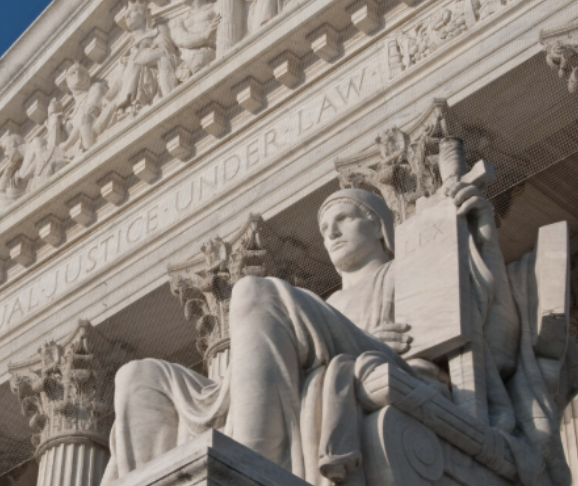
Three years after the Supreme Court struck down race-based college admissions, a group of Asian American parents says a Maryland school district simply found a new way to do the same thing. On Monday, the justices agreed to hear them out.
The case is Association for Education Fairness v. Montgomery County Board of Education. The parents, represented by the Pacific Legal Foundation, say Montgomery County, Maryland, built an admissions lottery for its top middle-school magnet programs that quietly pushes Asian American kids to the back of the line.
“After the Harvard case, universities continued to use proxies for race,” Pacific Legal Foundation senior attorney Erin Wilcox told the Daily Signal.
How the lottery works
The lottery covers humanities and STEM magnet programs at four middle schools: Takoma Park, Eastern, Roberto Clemente and Martin Luther King Jr. It took effect in the 2021-22 school year, according to Maryland Matters. Grades and test scores still count.
But the lottery compares each student only against students from elementary schools with similar poverty levels, Reuters reported, as cited by the Daily Signal. The parents say that formula makes it harder for Asian American children at high-performing, low-poverty schools to get in, no matter how hard they work.
“You’re using, in this case, geography as a proxy … to get the racial results that you want,” said Chris Kieser, another senior attorney at the foundation.
How the lower courts let it slide
U.S. District Judge Paula Xinis, an Obama appointee, threw out the parents’ lawsuit in 2022. The 4th Circuit Court of Appeals upheld that dismissal in February.
The 4th Circuit’s rule is the real problem. As Ilya Somin explained at the Volokh Conspiracy legal blog, the lower courts held that even a policy adopted specifically to cut one racial group’s admissions survives, as long as that group’s share of admitted students stays at least as high as its share of applicants. Under that approach, Somin wrote, “even the most blatant discriminatory motivations do not trigger strict scrutiny.”
That is the question the justices will now answer: whether parents must prove an “aggregate disparate impact” before a court will even look at evidence of intent.
The 4th Circuit first laid down that rule in its 2023 ruling in the Coalition for TJ case from Fairfax County, Virginia. The Supreme Court declined that case in 2024. Justices Clarence Thomas and Samuel Alito dissented, and Alito wrote, “The Court’s willingness to swallow the aberrant decision below is hard to understand.”
The Pacific Legal Foundation says it has reviewed similar “stealth” policies in Boston, New York City and Alexandria, Virginia.
Montgomery County Public Schools said it “remains committed to providing equitable access to rigorous opportunities for all students.” The local NAACP and several allied groups said the changes “opened doors” for students left out before.
The bottom line
The Constitution doesn’t say “equal protection, unless the bureaucrats are clever about it.” If a school board sets out to shrink the number of Asian kids in a program, it shouldn’t matter whether it uses a racial quota or a school-poverty formula. The intent is the offense.
The 4th Circuit turned that principle upside down. It told families that officials can target their children on purpose and still win, as long as the final numbers look tidy. That isn’t neutrality. It’s discrimination with better paperwork.
Arguments are expected in 2027, with a ruling by the end of June. Parents everywhere should be watching. A kid’s seat in a classroom should be earned, not assigned by someone’s spreadsheet.